No Admit - 100% Refund

NO ADMIT - 100% REFUND

  • Flag of Germany
  • We do your process

    With

    Integrity & Accountability

German Language Requirement

German Language Requirement
20

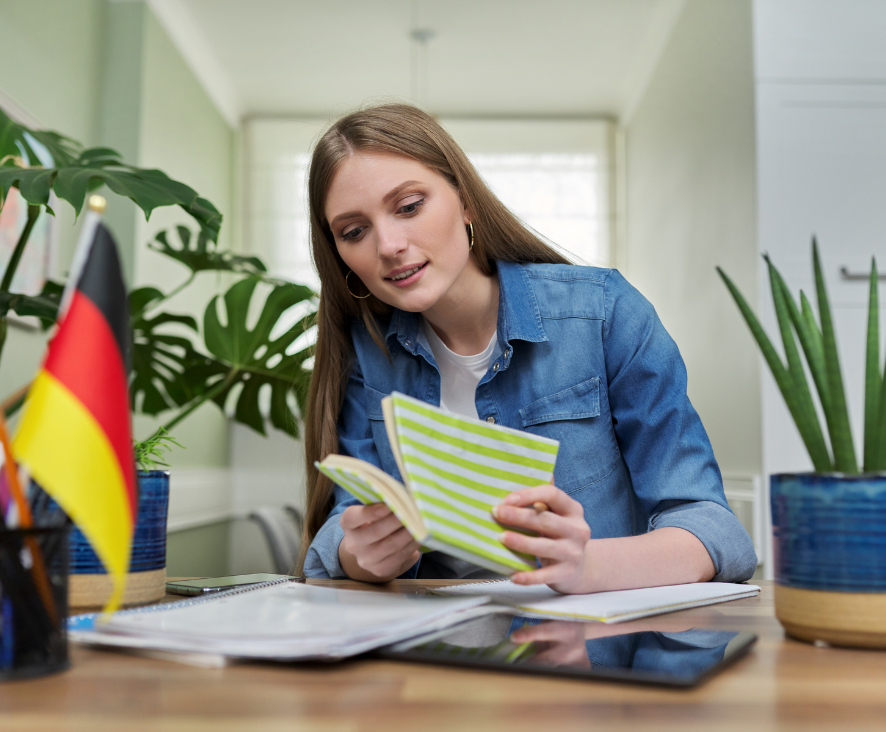
In general, your spouse must demonstrate basic proficiency in German to obtain a residence permit for family reunification. This means they should handle everyday tasks, like introducing themselves, asking for directions, or interacting in simple situations. However, exceptions apply depending on specific circumstances.

Exceptions to the Language Requirement
1. Highly Qualified Workers and Researchers: If you are a highly skilled worker or a researcher in Germany, your spouse may not be required to prove knowledge of the German language. This exception applies to individuals who hold an EU Blue Card or a permanent residence permit as a skilled worker, as well as those with specific academic or professional qualifications. These workers are often eligible for relaxed family reunification rules, including the language requirement.

2. Educational Qualifications and Certain Nationalities: If your spouse holds a university degree or higher, they might be exempt from the German language requirement. This applies if your spouse has completed university education in their home country or abroad, as their qualifications may be considered equivalent to language proficiency. Additionally, citizens of certain countries, such as Australia, Canada, Israel, Japan, South Korea, New Zealand, and the USA, are generally exempt from the language test requirement for reunification.

Why Learning German is Beneficial: Even if your spouse is exempt from the language requirement, learning some German will still be beneficial. Acquiring basic language skills will help your family feel more comfortable in their new environment. Being able to communicate in German is essential for day-to-day life, such as navigating public transport, understanding official documents, or interacting with neighbors and colleagues. Many communities in Germany offer language courses for immigrants, providing a great opportunity for your spouse to integrate more smoothly into German society.

While your spouse generally needs to demonstrate basic German language skills to obtain a residence permit, there are important exceptions for highly qualified workers, individuals with university degrees, and citizens from certain countries. Even if language proficiency is not mandatory in your case, learning German will make it easier for your family to settle in and adapt to their new life in Germany.

German Language Requirement

20

In general, your spouse must demonstrate basic proficiency in German to obtain a residence permit for family reunification. This means they should handle everyday tasks, like introducing themselves, asking for directions, or interacting in simple situations. However, exceptions apply depending on specific circumstances.

Exceptions to the Language Requirement
1. Highly Qualified Workers and Researchers: If you are a highly skilled worker or a researcher in Germany, your spouse may not be required to prove knowledge of the German language. This exception applies to individuals who hold an EU Blue Card or a permanent residence permit as a skilled worker, as well as those with specific academic or professional qualifications. These workers are often eligible for relaxed family reunification rules, including the language requirement.

2. Educational Qualifications and Certain Nationalities: If your spouse holds a university degree or higher, they might be exempt from the German language requirement. This applies if your spouse has completed university education in their home country or abroad, as their qualifications may be considered equivalent to language proficiency. Additionally, citizens of certain countries, such as Australia, Canada, Israel, Japan, South Korea, New Zealand, and the USA, are generally exempt from the language test requirement for reunification.

Why Learning German is Beneficial: Even if your spouse is exempt from the language requirement, learning some German will still be beneficial. Acquiring basic language skills will help your family feel more comfortable in their new environment. Being able to communicate in German is essential for day-to-day life, such as navigating public transport, understanding official documents, or interacting with neighbors and colleagues. Many communities in Germany offer language courses for immigrants, providing a great opportunity for your spouse to integrate more smoothly into German society.

While your spouse generally needs to demonstrate basic German language skills to obtain a residence permit, there are important exceptions for highly qualified workers, individuals with university degrees, and citizens from certain countries. Even if language proficiency is not mandatory in your case, learning German will make it easier for your family to settle in and adapt to their new life in Germany.

India Number 2
India Number 2
Thuringia (Thüringen)

Thuringia has become one of the most dynamic regions with high growth rates.
Thuringia is now considered a top location at the heart of Europe. Life in Thuringia is designed
to feel good: rich in quality of life, culturally diverse, and modern.
Particularities: Innovative companies are looking for international
professionals right at the heart of Europe: A nice place to live and work with your family.
Schleswig-Holstein

Schleswig-Holstein offers a professional environment with a strong middle class
and worldwide successful companies. Due to the proximity to Scandinavia, the federal state
maintains good networks with an international environment.
Particularities: Since 2015, Schleswig-Holstein has been covering
its energy needs with renewable energies only—especially wind power.
Saxony-Anhalt (Sachsen-Anhalt)

Saxony-Anhalt is a modern business and science location situated in the heart of Germany.
Universities, academies, and other research facilities, as well as local companies,
create a lively and innovative climate.
Particularities: Saxony-Anhalt has the highest density
of UNESCO World Heritage sites in Germany.
Saxony (Sachsen)

Saxony is an excellent location for international companies. Saxony boasts the
highest number of students who graduate with degrees in engineering, manufacturing,
and construction each year.
Particularities: South of Dresden lies the Saxon Switzerland
National Park - a popular destination for hiking and climbing enthusiasts.
Saarland

The federal state of Saarland has evolved from a traditional mining and steel location
into a modern, international business region.
Short distances and friendly people are what modern and vibrant Saarland is all about.
Particularities: One third of the Saarland area is covered with forest. This makes it
one of the most densely wooded federal states.
Rhineland-Palatinate

Rhineland-Palatinate is one of Europe’s high-tech regions. Its infrastructures – such as universities
and educational institutions, as well as beautiful natural and cultural landscapes – make the
state a lovely place to live.
Particularities: Modern letterpress printing was invented by Johannes
Gutenberg in Mainz, the capital of Rhineland-Palatinate.
North Rhine-Westphalia

North Rhine-Westphalia is home to one of the strongest industrial regions in the world and offers
one of the most vibrant cultural landscapes in Europe.
It is a diverse state with vibrant business centers and bustling cities.
Particularities: NRW is the German carnival stronghold. The Cologne carnival is one of the largest
and most famous carnival celebrations in the world.
Lower Saxony

Lower Saxony is Germany’s second-largest state. Strong companies, innovative minds,
and excellent research institutes have turned the state into an excellent location for
business and research alike.
Particularities: Hannover is one of the world's leading trade fair venues.
Mecklenburg-Vorpommern

Northern landscapes, the beautiful Baltic seaside, clear lakes, untouched nature, all of that defines
Mecklenburg-West Pomerania as a wonderful place to live.
It offers interesting opportunities for skilled workers and managers.
Particularities: With over 2,000 castles, Mecklenburg-West Pomerania
has the highest density of castles worldwide.
Hesse (Hessen)

Home to one of the largest European airports, Hesse offers an excellent transport network.
Similarly, well-known international industrial companies define Hesse
as a technology location in European markets.
Particularities: In Hesse, 'Ebbelwoi' stands
for apple wine. The drink has been a part of Hesse's culture for centuries.
Hamburg

Hamburg is a green city located in close proximity to the sea.
The metropolis offers plenty of things to do in your free time.
It is home to 500,000 companies with around 1.9 million jobs in its metropolitan region.
Particularities: Hamburg's port is considered the gateway to the world:
ships from all around the globe find their way to the hanseatic city.
Bremen

Bremen is innovative and creative. Parks, cultural diversity, lively neighborhoods, and the city's close
proximity to the sea give you many opportunities to enjoy your free time.
Particularities: Hanseatic city and high-tech location at the same time: More than 550
companies are located in the Bremen Technology Park.
Brandenburg

Brandenburg is an industrial state located at the center of major European routes.
It has been awarded the most dynamic business region in Germany three times and is a pioneer in renewable.
Particularities: With 3,000 lakes, the state of Brandenburg offers the most water bodies in the Federal Republic.
Berlin

Berlin is where the greatest number of new jobs are created in Germany.
Many companies are setting up their headquarters in the capital.
Open to innovation are the catchwords that best describe Berlin.
Particularities: Berlin is an attitude towards life.
People from over 190 different nations come together here.
Bavaria

Bavaria is a truly fascinating state. Its job market offers many possibilities for international qualified workers.
In addition, many small and medium-sized companies are always on the hunt for skilled professionals.
Particularities: Brass music, Dirndl & Lederhosen: The Oktoberfest in
Munich connects people from all over the world.
Baden-Württemberg

Baden-Württemberg is one of the cutting-edge industrial locations in the world.
Its economic strength and low unemployment contribute to its attractiveness.
Particularities: Baden-Württemberg is the birthplace of the first automobile.
Mercedes-Benz is still based in Stuttgart today.

Berlin


Capital:Stuttgart

Important Industries:

  • Automotive Engineering
  • Information and communication
  • Tech
  • Mechanical
  • Engineering & HealthCare
  • Electrical Engineering
  • Chemicals & Pharmaceuticals

Population: 111, 03, 043